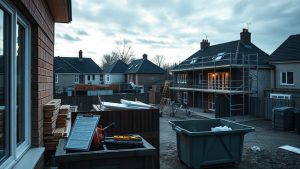
A client once sent me a budget with a line reading “groundworks and drainage: £48,000.” It looked tidy. Reasonable, even. Then the ground investigation came back with a band of soft clay sitting exactly where the foundations were meant to go, and that single line tripled. Nothing else in the budget moved. That is the nature of construction costs pros and cons explained properly: you are never looking at one number. You are looking at a set of trade-offs, each with a price attached to the choice you make.
This is how I walk first-time clients through it. Not a spreadsheet dump, but three decisions that shape almost every budget, followed by the thing everyone underestimates: contingency.
How a Construction Budget Actually Breaks Down
Before the trade-offs make sense, you need to know what you are trading. A domestic build or extension usually splits into five broad pots. Substructure — foundations, groundworks, drainage — typically runs 10 to 15 per cent. Superstructure, meaning walls, floors and roof frame, takes another 20 to 25 per cent. Then finishes, services and external works each claim their share, and professional fees sit on top at roughly 8 to 12 per cent.
The reason costs feel unpredictable is that these pots do not move independently. Spend less on insulation and your heating system has to work harder. Rush the programme and labour rates climb. Every line is connected to the next one, which is why a single figure quoted over the phone is worth very little.
What follows are the three trade-off pairs that come up in nearly every project I price. For each, I will tell you what you gain, what you give up, and who it suits.
Trade-Off One: Fixed Price Versus Cost-Plus
This is the first fork in the road, and it decides how much risk you carry versus how much you pay to hand that risk away.
What you gain with a fixed price. Certainty. You sign a contract for a set sum, and if the builder’s estimate was optimistic, that is their problem, not yours. For anyone borrowing money, this matters enormously — lenders want a number they can underwrite. You can plan cash flow, set a completion budget and sleep at night.
What you give up. Flexibility, and often a margin. A contractor pricing a fixed sum will build in an allowance for the unexpected, because they are absorbing the risk you have shed. That buffer might be 5 to 10 per cent. Change your mind mid-build and you will pay a premium for every variation, because you have handed the negotiating advantage to the other side.
What you gain with cost-plus. Transparency and adaptability. You pay the actual cost of labour and materials plus an agreed percentage or fixed fee. If you want to upgrade the kitchen halfway through, you simply pay the difference. There is no hidden risk premium baked into the price.
What you give up. Budget certainty. If steel prices jump or the ground turns out worse than expected, that lands on you. Cost-plus rewards clients who can absorb surprises and who want to stay involved in decisions.
Who this suits. Fixed price suits first-time clients, anyone with a tight lender deadline, and people who want to hand over the keys and forget about it. Cost-plus suits experienced developers, renovation projects where the existing structure is a mystery, and clients who are comfortable making decisions quickly as costs surface.
Trade-Off Two: Cheap Materials Versus Durable Ones
The second trade-off is the one clients most often get wrong, because the cheap option looks identical on day one.
What you gain with cheaper materials. Lower upfront cost, and sometimes a lot of it. A basic roof covering, standard windows, builder-grade fittings — these can shave tens of thousands off a project. If cash flow is the binding constraint, this is a legitimate choice.
What you give up. Lifespan, performance and resale value. Cheaper materials tend to fail sooner, insulate worse and cost more to maintain. A low-grade window that leaks heat for fifteen years can quietly cost more than the premium unit you rejected. Buyers and surveyors notice shortcuts, and they price them in.
What you gain with durable materials. Lower lifetime cost, better energy performance and a building that holds its value. A well-specified envelope reduces heating bills, needs less repair and often qualifies for better warranty terms.
What you give up. Cash today. Durable specification front-loads spending, and on a fixed budget it may mean a smaller building or a later start.
Who this suits. Cheap materials suit short-hold projects, temporary structures and anyone selling within a few years. Durable materials suit owner-occupiers, long-term landlords and anyone who would rather pay once than twice.
My rule of thumb: never economise on the things you cannot easily replace later. Foundations, drainage, the roof and the thermal envelope are buried or sealed in. Kitchen units you can swap in a weekend.
Trade-Off Three: Fast Build Versus Careful Build
The third trade-off is time, and time has a price that rarely appears on the quote.
What you gain from a fast build. Lower preliminaries — the site setup, scaffolding, plant hire and site management that accrue weekly. Finish sooner and you stop paying rent, start earning rent, or simply stop watching the interest clock tick. Speed also reduces exposure to price inflation on materials you have not yet bought.
What you give up. Quality control and cost control. Compressed programmes mean trades overlapping, which means mistakes get covered up before anyone inspects them. Labour gets rushed or premium-priced. And when you hurry, you tend to accept whatever is available rather than what you specified.
What you gain from a careful build. Better workmanship, fewer defects and, counterintuitively, often a lower final bill. Rework is the most expensive item in construction, and it thrives on haste.
What you give up. Time, and the carrying costs that come with it. A build that runs three months longer may add thousands in rent, loan interest and site overheads.
Who this suits. Fast builds suit commercial projects with a hard opening date — a shop that must trade by a season, a rental that must be let. Careful builds suit owner-occupiers, heritage work and anything where defects would be costly to fix later.
Contingency: The Line Everyone Cuts and Everyone Regrets
If you take one thing from this, take the contingency. A contingency is not padding or a slush fund for nice-to-haves. It is the money that pays for the things you cannot yet see: the unexpected ground conditions, the asbestos in the ceiling, the survey that missed a crack.
For a straightforward new build, hold 5 to 10 per cent of the contract sum. For a renovation, hold 10 to 15 per cent, because you are buying a building you have not fully opened up. For anything involving an old structure, a listed building or a basement, go higher.
Here is the discipline that matters: contingency is not spent on upgrades. The moment you dip into it for a better kitchen, you have removed your protection and converted a reserve into an overspend. Keep it separate, track it openly, and only release it against genuine unknowns.
Clients who cut contingency to win a tender are the ones who come back six months later asking how the budget went so wrong. It rarely goes wrong because of one disaster. It goes wrong because ten small surprises each looked affordable in isolation.
Frequently Asked Questions
Is a fixed price always the safer choice?
Safer for your budget, not always cheaper overall. You are paying a premium for someone else to carry the risk. If the project is well defined and the ground is known, that premium may be unnecessary. If the scope is uncertain, it is money well spent.
How much should I really allow for contingency?
Five to ten per cent for a new build, ten to fifteen for a renovation, and more where the existing structure is old, listed or partially unknown. Treat it as insurance, not as spare cash.
Where is it worth spending more, and where can I save?
Spend on the fabric: foundations, drainage, roof, insulation and windows. Save on finishes, fittings and anything you can replace later without disturbing the structure. Those are the decisions that survive contact with the future.
Construction costs pros and cons explained honestly come down to one idea: every saving is a risk you have chosen to keep. Fixed price hands risk to the builder and charges you for it. Cheap materials hand risk to your future self. Speed hands risk to quality control. None of these choices is wrong. The mistake is making them by accident, or pretending a single number can spare you from deciding.