I Tested a Desentupidora Saúde Emergency Callout: What You Must Verify Before Letting Anyone Touch Your Pipes
Your drain backs up at 9 p.m., water pools around the floor drain, and the first company that answers the phone sounds reassuring. That was exactly my situation in a Saúde apartment block, and the callout taught me more about safety and trust than any brochure ever could. If you are searching for a reliable desentupidora Saúde right now, the short answer is this: verify identity, equipment and pricing before anyone opens a pipe, and prefer a firm that handles emergencies as a routine, not an afterthought.
The problem I actually had, before any company arrived
My building sits on an older street in the Saúde district, where tree roots and decades-old clay pipes meet newer construction. The kitchen sink drained slowly for a week, then stopped completely, and the building’s floor drain began to gurgle. That gurgling is the detail most people ignore. It usually means the blockage is deeper in the shared stack, not just under your own sink.
I called three numbers. One quoted a price on the phone without asking a single question. Another promised a technician “in twenty minutes” with no name or vehicle details. The third asked about the pipe material, the floor plan and whether the building had a grease trap. Only that third call felt like a real diagnostic conversation.
What happened when the technician arrived
The technician showed up in a marked van with a uniform and a printed work order. Before touching anything, he asked to see the building’s drainage layout and checked the cleanout access in the service corridor. That first ten minutes told me more than the price quote did.
Identity and authorization checks
A legitimate crew should be able to show a company name, a technician ID and a contact number that matches the one you called. In a condominium, the síndico or building manager should confirm access before work begins. If someone refuses to identify themselves or pressures you to skip the building’s authorization, treat that as a stop sign.
Equipment brought to the job
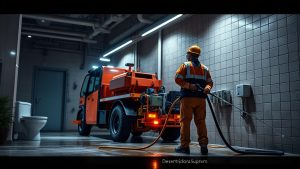
The van carried a mechanical auger, a hydrojetting hose and a camera inspection reel. That combination matters. A simple plunger or hand snake can clear a sink trap, but it cannot address a root intrusion or a grease blockage in a main line. When I later compared notes with a neighbor who had used a different firm, the difference was obvious: the cheap crew arrived with one hand tool and left the deeper problem untouched.
How the diagnosis and clearing actually worked
The technician started with a camera inspection through the cleanout. The footage showed a grease and soap buildup combined with root hairs entering a joint about six meters down. He explained the finding in plain language, showed me the screen, and only then proposed a method.
- Camera inspection to locate the blockage and confirm pipe condition.
- Mechanical auger to break up the soft blockage and restore partial flow.
- Hydrojetting at controlled pressure to scour the pipe walls and remove residue.
- Second camera pass to confirm the line was clear and the pipe was not damaged.
That last step is the one people skip. A second camera pass is your proof that the job is actually finished, not just flowing for an hour. Without it, you are paying for a temporary relief.
What I learned about pricing and hidden charges
The quote I received broke down into callout fee, inspection, clearing and a possible camera follow-up. Nothing was added after the work. That transparency is not universal. In my research before booking, I found that emergency rates in São Paulo often rise after business hours, and some firms charge separately for equipment that should be part of the standard service.
Ask for the total in writing before work starts, including what happens if the blockage turns out to be in a shared line or requires a return visit. A firm that handles desentupidora Saúde São Paulo SP emergencies regularly will have a clear rate structure ready, because night and weekend calls are its normal business.
| Check | Why it matters |
|---|---|
| Written quote before work | Prevents surprise charges after the pipe is open |
| Camera inspection offered | Confirms the real cause instead of guessing |
| Technician identification | Protects you and your building’s access rules |
| Second camera pass | Proves the blockage is cleared and the pipe is intact |
The safety details that separated a professional job from a risky one
Drain work involves sewage, chemicals and confined spaces, so safety is not a formality. The technician wore gloves and eye protection, laid protective sheeting over the corridor floor, and disinfected the area before leaving. He also warned me not to flush chemical drain cleaners into the line afterward, because they can damage older pipes and mask a recurring problem.
For buildings, the bigger risk is unauthorized access to shared shafts and rooftops. A crew that works without the síndico’s knowledge can leave cleanouts open or disturb gas and water lines. Never let an emergency callout bypass the building’s access protocol, even at midnight. The few minutes lost are worth the accountability.
How I judged whether the company could be trusted afterward
Trust is built after the van leaves. The firm sent a short report with the camera images, the method used and a recommendation to schedule preventive hydrojetting in the shared line. It also followed up two days later to confirm the drain was still flowing. That follow-up is rare, and it is a strong signal that the company treats maintenance as a relationship rather than a one-off sale.
I also checked whether the company advertised preventive maintenance for condominiums. A firm that only appears for emergencies tends to disappear once the water flows. One that offers scheduled cleaning of grease traps, storm drains and septic systems has an incentive to do the job properly the first time.
Lessons from the callout, in the order they mattered
First, the phone conversation is a test. A company that asks diagnostic questions before quoting is already more trustworthy than one that guesses. Second, demand identification and building authorization before any tool touches a pipe. Third, insist on camera inspection and a second camera pass, because those two steps convert a guess into a verified repair.
Fourth, get the price in writing, including after-hours and return-visit terms. Fifth, keep the report and schedule preventive work so the same blockage does not return next season. When I needed a desentupidora em Saúde São Paulo SP that could handle a real diagnosis rather than a quick plunge, those five checks were what separated a stressful night from a properly solved problem. Use them before you hand over your keys or your payment.